AI Visibility · Answer Engine SEO

AI Search Optimization for ChatGPT, AI Overviews & Answer Engines

JoinRankPilot helps prepare pages for AI-led discovery by checking entity clarity, answer-ready structure, topical depth, and internal context — then turning the gaps into guided SEO missions.

Visibility workflow
01Start with one URL and target topic.
02Check entity clarity, answer fit, trust signals, and coverage depth.
03Turn gaps into guided missions instead of another static report.
04Validate improvements and expand into content, internal links, and growth workflows.
What JoinRankPilot checks

AI visibility needs more than keywords

AI search optimization needs clear entities, useful answers, supporting context, and a trustworthy structure. JoinRankPilot keeps those improvements connected to the mission workflow instead of treating them as random tasks.

Entity clarity

Check whether the page clearly explains the brand, topic, audience, and purpose so AI systems can understand what the page should be associated with.

Answer-ready structure

Identify whether important questions, summaries, headings, and sections are structured clearly enough for answer-first search experiences.

Topical coverage gaps

Find missing subtopics, supporting context, and proof points that make a page easier to trust, summarize, and cite.

Internal context

Connect AI visibility with internal linking and authority planning so the page is supported by the right surrounding content.

SaaS evaluation guide

How JoinRankPilot evaluates SaaS pages for AI search optimization

For SaaS websites, AI search optimization is not just a keyword pass. The page has to explain the product, the buyer, the use case, the workflow, and the proof clearly enough for people and answer engines to evaluate it.

Positioning and audience fit

A SaaS page should make the product category, primary user, job to be done, and business outcome obvious without forcing AI systems or buyers to infer them from feature labels.

Problem-to-workflow coverage

Strong pages explain the pain, the workflow, the inputs users provide, and the output they can act on. Thin pages often jump straight from feature names to a call to action.

Proof, limits, and trust signals

Screenshots, process details, validation steps, support links, and clear limitations help the page read like a real product evaluation instead of a claim list.

Decision support for buyers

JoinRankPilot looks for comparison angles, objections, edge cases, and next steps that prospects may ask about in ChatGPT, AI Overviews, or a sales conversation.

Examples to evaluate

Pages that usually need clearer AI-ready context

Product pages

Clarify the core workflow, who uses it, what changes after adoption, and which supporting pages explain pricing, integrations, proof, or setup.

Use case pages

Match the page to a specific audience problem, answer common buying questions, and connect the page to related features, examples, and next-step content.

Comparison pages

Explain the evaluation criteria honestly, define where the product is a fit, and avoid vague claims that do not help a buyer or answer engine compare options.

Edge cases

Common SaaS gaps JoinRankPilot turns into missions

  • Multi-product pages may need clearer internal links so each product, category, and use case has its own context.
  • New category pages may need definitions, synonyms, and problem framing before AI systems can map the page to the right topic.
  • Demo or signup pages may need supporting explanation nearby so the CTA is not the only visible answer.
Worked examples

Turn common page gaps into practical missions

AI search optimization works best when the output is specific enough to act on. These examples show how JoinRankPilot can translate a page issue into a focused mission without inventing rankings, citations, or proof.

Pricing-adjacent SaaS page

Issue: The page lists plan options, but it does not explain which buyer, team size, or workflow each path is meant to support.

Mission: Add a short decision guide, link to the product workflow, and answer the questions a buyer would ask before choosing a plan.

Result: The page becomes easier for people and answer engines to connect to commercial investigation intent without changing the offer itself.
Feature page with thin context

Issue: The page names a feature, but it does not define the problem, input, output, or success criteria clearly enough.

Mission: Add a use-case summary, example output, proof or limitation notes, and links to related workflow pages.

Result: The feature is no longer isolated; it has enough surrounding context to support AI search optimization and buyer evaluation.

Comparison page with vague claims

Issue: The page says the product is faster or easier, but it does not describe the criteria a buyer should use to compare options.

Mission: Replace unsupported claims with comparison criteria, fit guidance, tradeoffs, and next-step links for deeper evaluation.

Result: The page can satisfy comparison intent more honestly while still guiding readers back to the product workflow.

Use case

Pre-launch page review

Check a new product, use case, comparison, or pricing-adjacent page before it is published so unclear category language and missing buyer context are fixed early.

Use case

Post-crawl mission prioritization

Use the output to separate technical trust, content depth, entity clarity, and internal-linking work instead of treating every recommendation as equally urgent.

Use case

Demo or plan support

Review whether pricing-adjacent content explains what users receive, what happens after signup, and which pages reduce buyer uncertainty.

Use case

Topical cluster planning

Turn recurring gaps into supporting guides, examples, FAQ pages, and best-practice content that can link back when the main tool page is the best next step.

Common mistakes

Mistakes that make AI visibility harder to evaluate

  • Treating AI search optimization as a one-time checklist instead of a page-by-page evaluation workflow.
  • Adding FAQs that repeat marketing claims instead of answering practical objections, workflow questions, and interpretation questions.
  • Publishing product pages with screenshots or CTAs but no explanation of who the page is for, what the input is, and what output users receive.
  • Linking only from global navigation instead of using contextual links from guides, examples, and best-practice pages.
Supporting resources

Build a stronger AI search optimization content cluster

Tool pages are stronger when they are supported by guides, examples, and FAQ content that answer adjacent search intent. These supporting pages give readers natural next steps while keeping this page focused on the JoinRankPilot visibility workflow.

Product walkthrough

See the AI search visibility workflow in action

These real JoinRankPilot screens show how an AI search optimization audit turns into a connected mission workflow: score the page, review alignment, open the active mission, validate improvements, and strengthen supporting internal context.

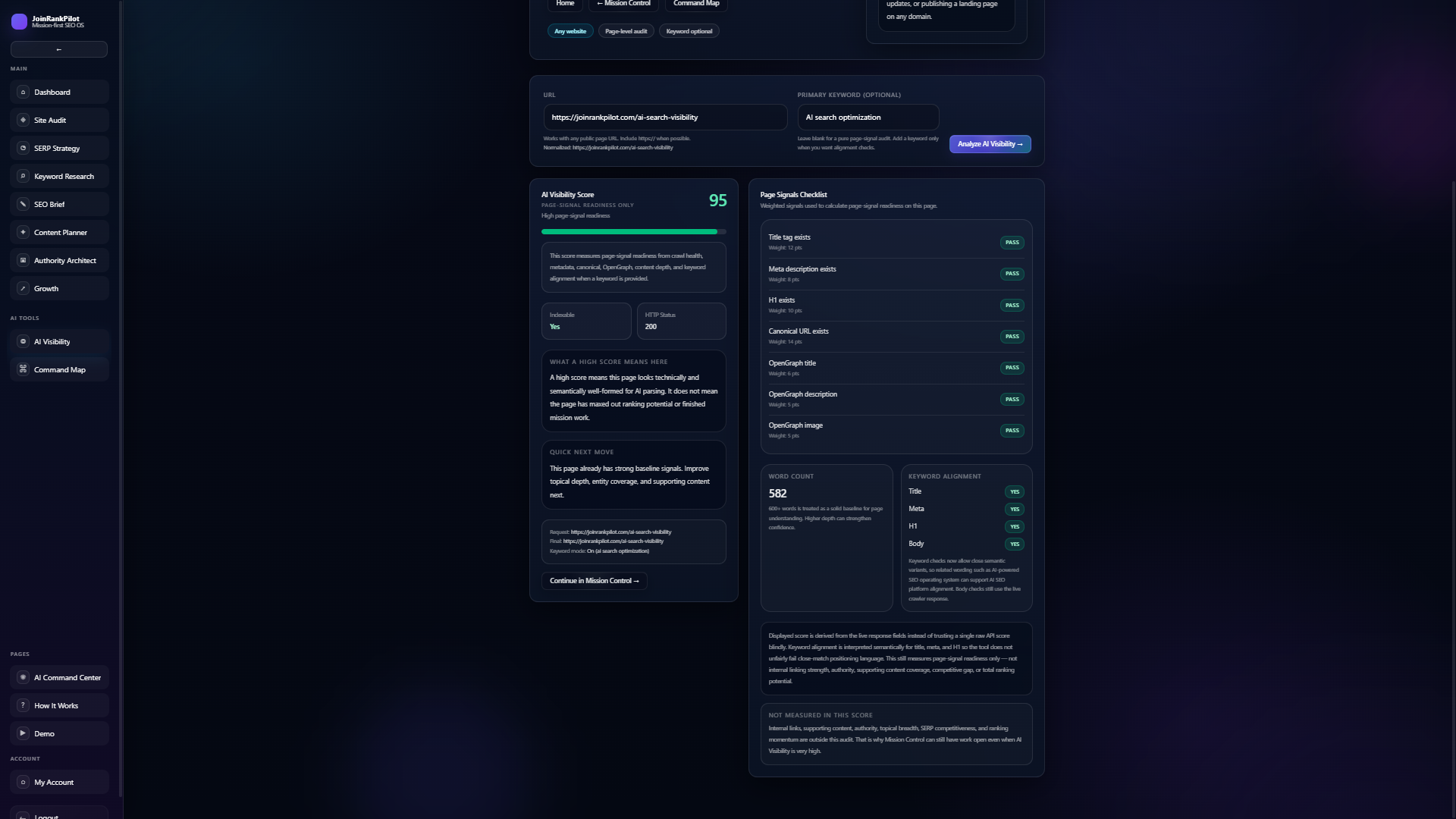
AI visibility score and keyword alignment

Run a live page-level AI search optimization check and see whether title, meta, H1, body, indexability, canonical, and OpenGraph signals are ready.

JoinRankPilot AI Visibility score showing keyword alignment for AI search optimization

Command Center execution workflow

Move from the visibility check into Mission Control, where JoinRankPilot keeps the URL, keyword, active mission, validation state, and technical trust signals connected.

JoinRankPilot Command Center showing an active AI search optimization mission

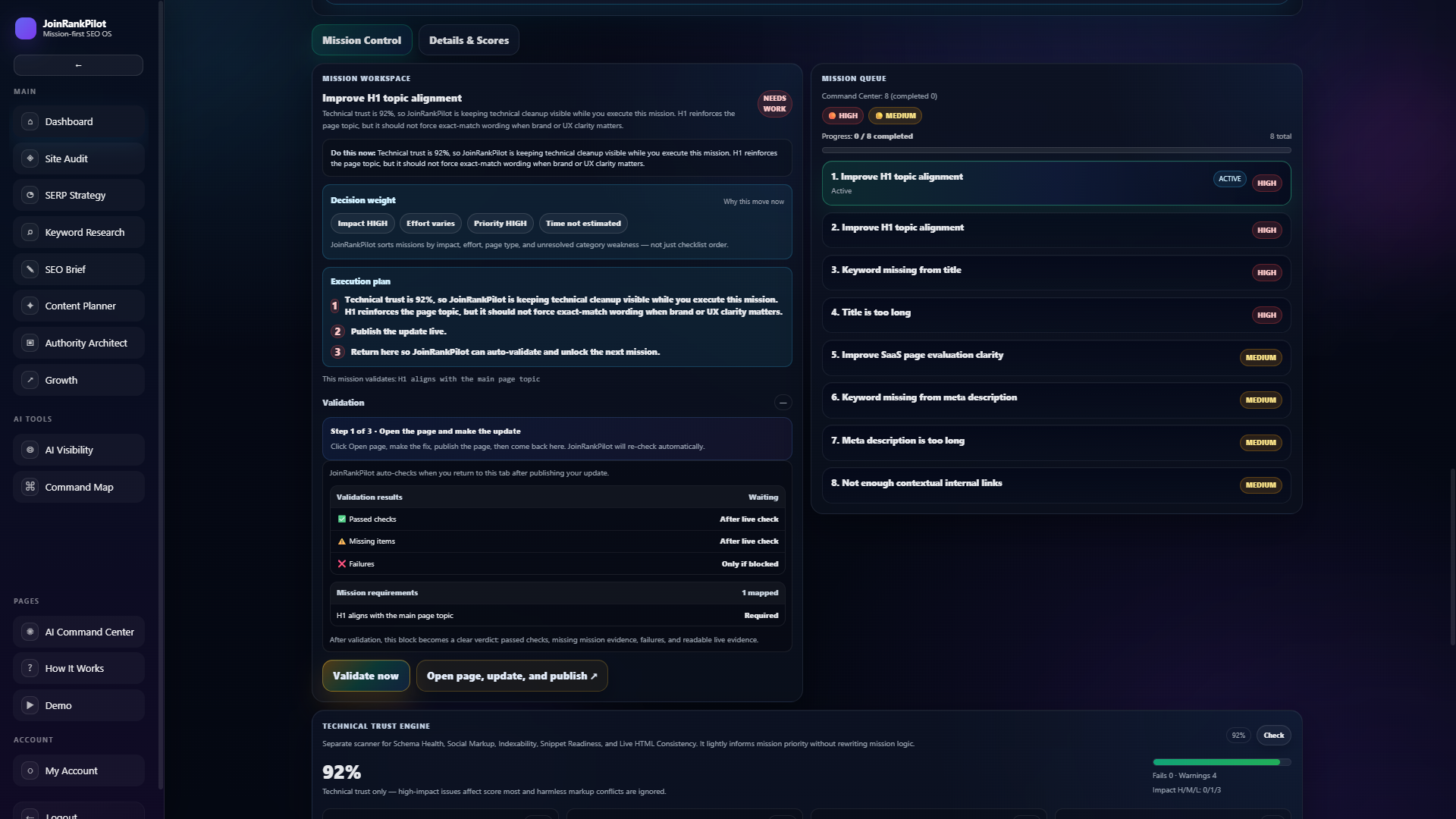
Mission queue and validation steps

Prioritized missions explain what to improve, why it matters, and how to validate the change after publishing.

JoinRankPilot mission workspace with prioritized SEO missions and validation workflow

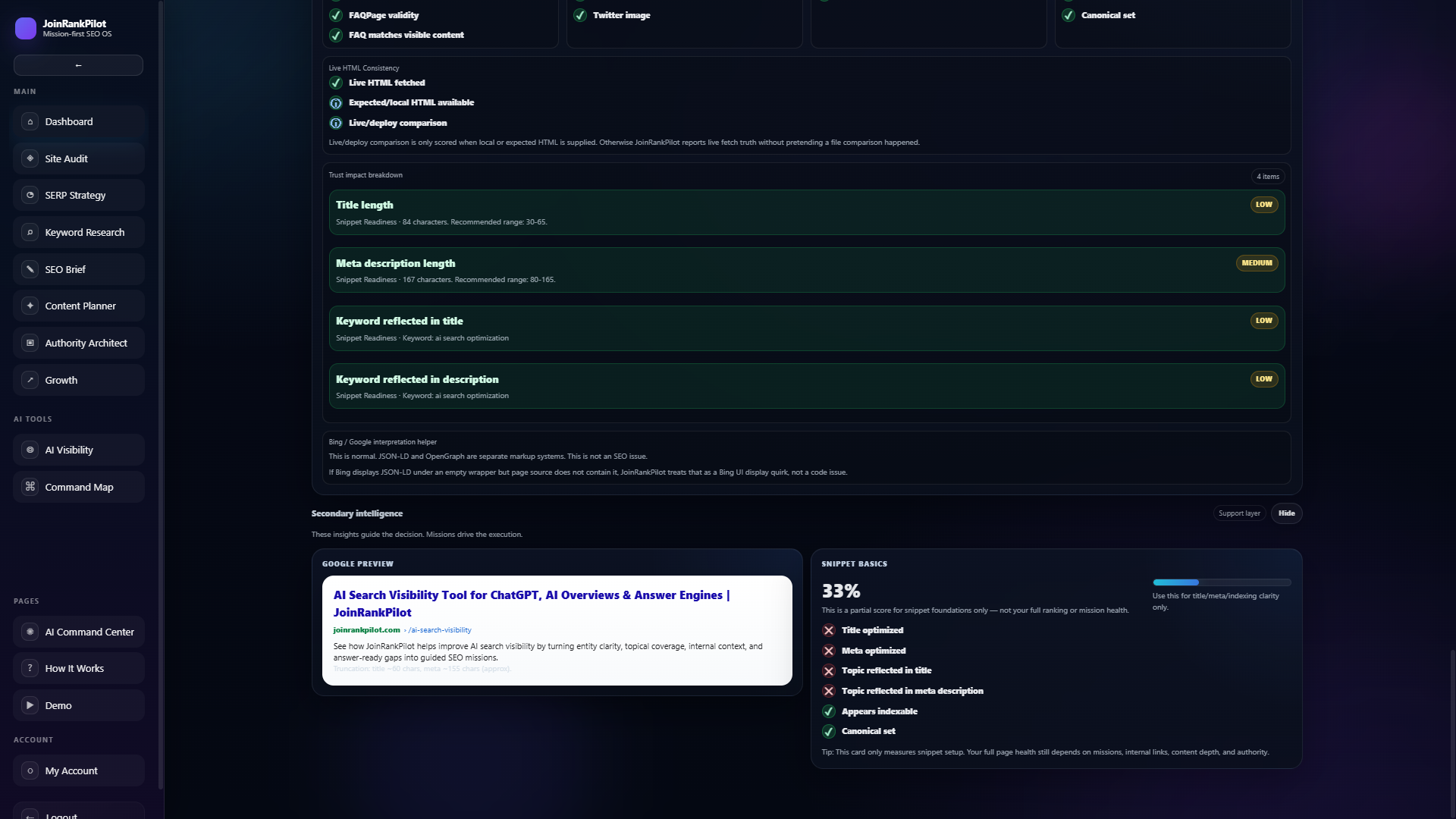
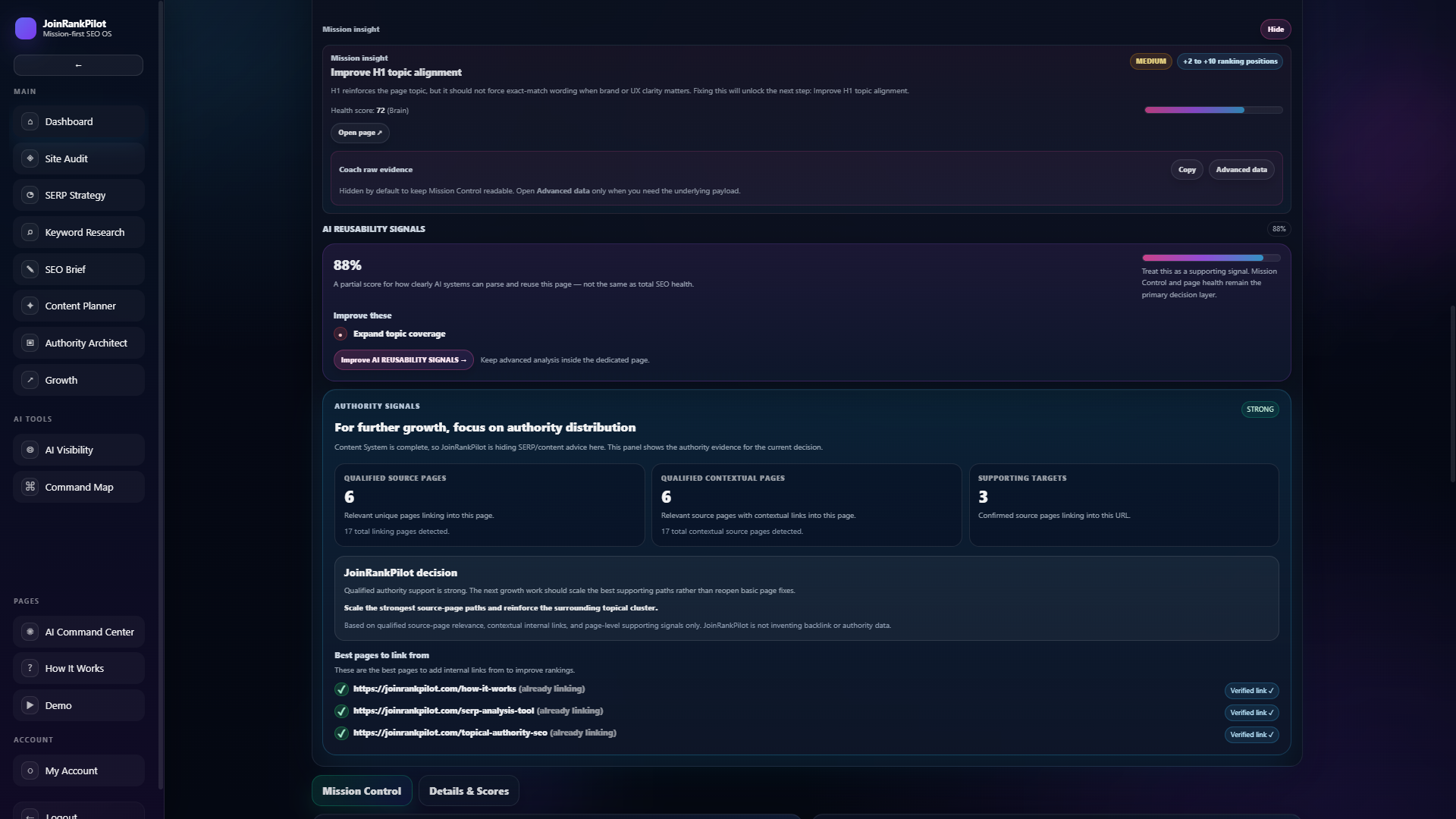
Authority and internal context signals

The workflow also checks supporting pages, contextual internal links, and authority signals so AI search visibility work does not happen in isolation.

JoinRankPilot authority signals showing supporting source pages and internal link recommendations
Mission-first difference

From visibility gap to executable mission

A generic AI SEO checklist can tell you to add entities or FAQs. JoinRankPilot is built to decide what should happen first, connect it to the target page, and keep the work inside the same execution and validation flow.

Example mission output
Mission

Strengthen answer-ready entity coverage for the target page.

Add a clearer definition, improve supporting sections, link to relevant context, and make the page easier for search and AI systems to interpret.

FAQ

AI search visibility questions

What is AI search visibility?

AI search visibility is how well a page can be understood, summarized, selected, or cited by AI-led discovery surfaces such as answer engines, AI summaries, and conversational search systems.

Is this different from traditional SEO?

It builds on traditional SEO, but it focuses more heavily on entity clarity, answer-ready structure, topical completeness, trust signals, and the surrounding context that helps AI systems interpret a page.

Does JoinRankPilot promise AI citations?

No. AI visibility cannot be guaranteed. JoinRankPilot focuses on the practical work that improves readiness: clearer entities, stronger content coverage, better internal context, and mission-based execution.

How does this connect to missions?

JoinRankPilot translates visibility gaps into guided SEO missions so users know what to improve first and how the work connects to the wider SEO workflow.

Which SaaS pages should I evaluate first?

Start with pages that influence discovery or revenue: product pages, use case pages, comparison pages, pricing-adjacent pages, and pages that already rank but do not explain the product clearly enough.

What does JoinRankPilot look for on a SaaS page?

It looks for clear category language, user and use-case fit, answer-ready sections, proof and limitations, internal context, and practical next steps that can be turned into SEO missions.

What output should I expect from an AI search optimization check?

The useful output is not just a score. You should know which entity, coverage, structure, trust, or internal-context gap matters most and what mission should be completed next.

Can this help with pricing or comparison pages?

Yes. Pricing-adjacent and comparison pages often need clearer fit guidance, decision criteria, limitations, and contextual links so buyers can evaluate the page without relying on vague claims.

What should I fix first if a page is weak?

Start with the gap that blocks understanding: unclear page purpose, missing audience or product category, thin answer coverage, weak proof, or missing internal links to supporting context.

How often should I recheck AI search visibility?

Recheck after publishing material content changes, adding supporting pages, changing metadata, or restructuring internal links. The goal is to validate the page after each meaningful mission.

Start with one URL and one topic

See what your page should improve first

Run the free preview to get your first guided missions and understand how JoinRankPilot connects AI visibility with SEO execution.